
Stretch and Relax
Over ten years ago, I started taking yoga. I was beginning to get a lot of injuries and I thought it was probably because I was doing too many high-impact, high-intensity activities without enough stretching. The injuries were a message from my body telling me I needed to balance the way I exercised. At that time, I thought yoga was basically an activity where you learned how to stretch and relax.
My first class started with a breathing exercise, followed by three Om, then a Sanskrit chant. I knew Om had some religious significance…I wasn’t sure what it was, but I was pretty sure that I didn’t believe in it or buy into it. I didn’t understand the Sanskrit chant and it felt wrong to chant something when you don’t know exactly what the words mean.
It didn’t feel authentic for someone like me – white, middle-class, American mom, to be appropriating something from an ancient religion from India, especially since I was essentially a secular humanist non-believer, although at the time I wasn’t even religiously knowledgeable enough to know that that was the name for what I was. I tended to only recognize the negative aspect of religion and I basically dismissed everything religious as implausible, wishful-thinking, simplistic pablum…not really something of value that I needed in my life.
Plus, Fifteen minutes into yoga class and we hadn’t done anything! I was impatient to get started with the “real work,” and then move on to mastering relaxing, dammit.
Breathe
We started stretching and our teacher gave detailed directions on when and how to breathe for every stretch. She used a lot of simple images as metaphors that allowed us to visualize filling not just the chest, but the sides, back body, collar bone and even the head with air when we inhaled. She told us to breathe into the areas where the muscles were tight.
My brain told me that the air I breathe just goes in and out of my lungs, and I knew it wasn’t really moving around my body or into my muscle fibers, but it felt like it was and I could feel my muscles “let go” whenever I “breathed into” those tight areas.
I had never thought consciously about my breath this much. In spite of myself, I began to feel different…lighter, more relaxed, more energized. My favorite part was the last pose…shivasana, corpse pose, 15 minutes lying on my back. My mind was still and I felt content.
Now, I had been married to conscientious daily meditator for over ten years and I had previously tried to meditate a number of times but I could never get the hang of it. Now here, after just one yoga class, I had a tiny glimpse of what it could be.
At the time, I didn’t recognize that it was sort of a breakthrough for me. I just knew it felt good and I wanted to do it more. It worked! I didn’t know why but it did.
Even with those positive feelings, I didn’t join in singing Om in yoga classes for quite a long while. I just didn’t feel it. (Kind of like the first time you say “I love you” to someone. You realize it’s important to really feel it before you commit to uttering it.)
Ohm

But after several years (hundreds of classes), just hearing the sound of Om would bring forth the bodily experiences I knew were going to follow in the class. Without any further effort, my breathing would slow, my body would relax, body awareness would heighten, my heart would lighten and I would experience a feeling of pleasant expectation for what was to come.
The repetition of hearing Om accompanied by the benefits of the class activated the pathways of my mind and body. It was a shortcut…it got me “there” faster. It was a Pavlovian response, an involuntary reaction, a conditioned reflex from hearing the syllable before, during and after yoga. When I became aware of this, I started joining in. After awhile, I surprised myself when I realized I was performing a spiritual practice.
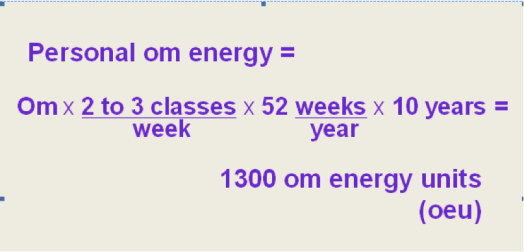
Personal OM Energy
Here is the formula that describes my personal OM energy:
Universal OM Energy
Now I know that Om is more than a personal spiritual practice. I’m part of something bigger, something I share with billions of people, people living now and people that lived and chanted Om during the last 2500 years.
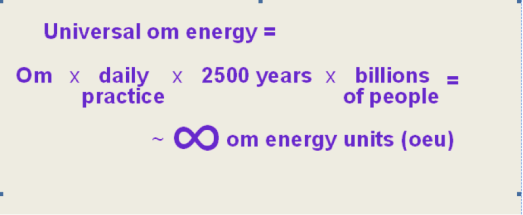
Can you conceive of the unbelievable arrogance of my initial casual dismissal of something as sacred and ancient as Om? Any vessel that can contain and manifest thousands of years of billions of people’s mind/body/soul energy should not be dismissed. The level of my ignorance about its sacred meaning and its power to change body, breath, mind and soul for countless numbers of people from all walks of life through many ages of human history is unbelievable.
The Holy Trinity
Om may have started as merely a simple syllable accompanying the first rudimentary yoga exercises. But its meaning has evolved over several millennia.
When chanted, Om consists of three sounds…A – U – M.

The silence following Om represents the fourth transcendent state, which is fulfillment, its essence being the fully realized Self.
Hajime Nakamura, Trevor Leggett, A history of early Vedānta philosophy, Part 2.
Searching
In the past, I have tried to understand how anyone could believe in God because I could never get the hang of it. All of my adult life, my brain has been telling me that God doesn’t exist. Like chanting Om, I had avoided using the word God, because I dismissed the idea of God. The way I imagined God–an all-seeing, all-knowing, all powerful Zeus-like father figure, a sky bully passing judgment on us children from the clouds–was so rudimentary and narrow that it was easy to dismiss.
Isn’t it arrogant to casually dismissal of something as sacred and ancient as god? Any vessel that can contain and manifest thousands of years of billions of people’s mind/body/soul energy should not be dismissed. The level of my ignorance about its sacred meaning and its power to change countless numbers of people from all walks of life through many ages of human history is unbelievable.
More Om
In the book ,Chanting and Meditation, Amit Ray states:
Om is not just a sound or vibration. It is not just a symbol. It is the entire cosmos, whatever we can see, touch, hear and feel. Moreover, it is all that is within our perception and all that is beyond our perception. It is the core of our very existence. If you think of Om only as a sound, a technique or a symbol of the Divine, you will miss it altogether. Om is the mysterious cosmic energy that is the substratum of all the things and all the beings of the entire universe. It is an eternal song of the Divine. It is continuously resounding in silence on the background of everything that exists.
How’s that for a smart definition of God? When I read it, I had a tiny glimpse of the kind of God that might allow my mind to “let go” of utter disbelief.
At the time, I didn’t recognize that it was sort of a breakthrough for me, I just knew thinking about it felt good and I wanted to delve more deeply into it. I didn’t know why but I did. In spite of myself, I began to feel different…lighter, more relaxed, more energized about stretching my own definition of God.
Like Om, I had previously avoided using the word God, because I dismissed it and I didn’t believe in it. Once I was shown different ways to imagine divinity and my thinking expanded the definitions, I could believe in them and feel them. Once I could feel them, I couldn’t dismiss them. The word “god” became a shortcut to the expansive way I thought about all that is within our perception and all that is beyond our perception.
Perceptions of God
Maybe the truth is that it isn’t perceptions of God that are different for each person, maybe God itself is different for each person. Maybe people don’t just perceive God differently…maybe God is actually different for each of us. Maybe God actually is what each person needs God to be:
Some people need God to be a Father, so maybe God is their Father.
Some people need God to be a Mother, so maybe God is their Mother.
Some people need a God that they can talk to, so God listens to them.
Some people need a God that is involved and intervenes in life, so what happens to them is because of God.
Some people need a God that isn’t involved and doesn’t intervene in their life, so what happens to them is not because of God.
Some people need a God that appears in nature, or in love, or in health or in illness, so for those people God resides there.
Some people feel God above the earth, some people feel God outside their body, and some people feel God inside, so God makes a home wherever those people feel the presence.
Some people need no God at all, so they get a life without God and they’re still complete.
The good thing about thinking this way is that you simply have to decide what kind of God you need, and then God is that for you…and you can change your mind. In the middle of a crisis, if you need a God you can talk to, God is listening. If you feel God in your love for your partner or your children or your parents or a friend or even in a stranger next to you in a protest march, then God is there. If you feel God with you on a mountain bike ride in a canyon, he…or she…or it (whatever you want God to be) is there. If you never feel God, then God is not there, and it’s okay.
Suspend
UU Minister Forrest Church says:
If you believe in God, look again at what you believe in and cast it into question. Comfortable beliefs lack the element of surprise that invokes awe. So expand your frame of vision. Suspend your belief. Your God is probably far too small to be deserving of the name. By the same token, if you doubt God’s existence, the God you disbelieve in is probably even smaller. So take a chance. Suspend your disbelief.
~Written in July 2012
 School of Thought