
The Normal Distribution
by Eileen Maurer
October 2015

If I asked everyone in a room to guess how many jelly beans were in this jar, we would have a range of answers, from wildly low estimates all the way up to wildly high estimates. Most of the answers would be grouped around the actual number.
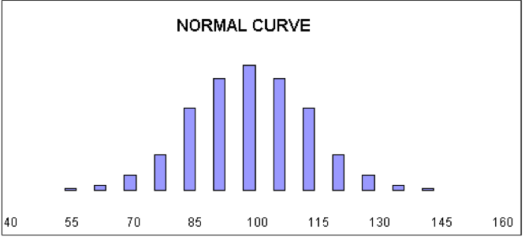
If I graphed the guesses, it would be a normal distribution.
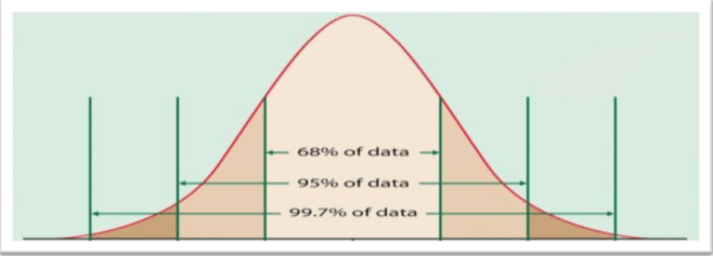
The few people who guessed really low are out there on the left tail. The few people who guessed really high are out there on the right tail. But the majority of people are grouped around the middle.
Now it’s possible, even likely, that no one in here would guess the exact right number, but the average of all the answers would be as close or closer to the truth than any of the single guesses.
Reality
Reality is always greater than our observations of it. No one person, or one group, has the entire truth, but the collection of all of their viewpoints comes the closest to reality. Rather than just sticking to viewpoints that are similar to yours, the more observations you get from a wider variety of points of view, then the clearer your picture of reality is. The truth can’t be obtained from any one person, or one group, but the more opinions you have, the closer you get to the actual truth.
And the extremes are just as important to the accurate picture as the middle. Even though there are less of them, and you know they are really off, wrong or weird, the measurement is more accurate if you include the extremes. You end up being less accurate if you leave someone out, even if you know they are wrong.
Now the normal curve doesn’t represent every complex cultural or political or national debate. But it serves as a good metaphor for issues with a web of interconnected beliefs that exist on a continuum.
The Extremes
None of us is completely liberal or completely conservative on every single issue, in every single circumstance. Most of us fall somewhere in the middle.
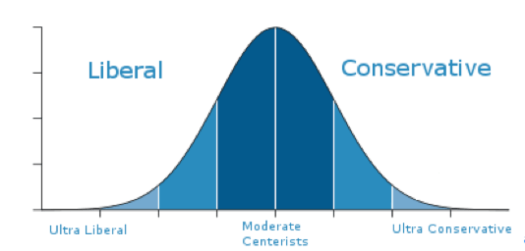
Even though the majority of us fall in the middle, there are spiritual reasons that we should not disregard the extremes. We can only learn the lessons of the extremes by observing or experiencing those extremes. That is, learning from observing the consequences of being extreme is what encourages most of us to live in the middle.
Even if we somehow could eliminate the extremes in a situation, it’s likely that without the lessons of extremism – the truths that hold most of us in the middle – some of us near the extremes would slide out to fulfill the greater purpose met by the extremes.
It’s just a shame that the extremes get all the attention and the media coverage. That’s because extremes incite fear and anger – strong reactions.
The thing is, we are often made to feel that we have to choose one of the extremes to identify with. If we don’t we are “traitors” to our label. The extremes try to make you choose them, because there’s so few of them that they’re lonely and they want company that will reinforce their idea that they represent the whole Truth.
The Middle
Now, the extremes are so far apart, we cannot ever hope to reconcile them; so all of the work of reconciliation must take place in the middle. There are so few extremes and they refuse to mix well with others who have contrasting opinions so they never hear anything different from their own thoughts.
The middle invites conversation, consideration, tolerance, acceptance. The middle is where shifts of opinion can take place because the middle is where people are exposed to a variety of opinions. We can spend all of our energy and time trying to eliminate or coerce the few extremes…or we can concentrate on shifting the gigantic middle just a little bit…what approach makes the biggest difference to the most people in our culture?
While it’s true that the position of the extremes does define the middle, and the extremes do try to pull people from the middle to the outside – by any means necessary – the gigantic middle is where the true power resides, and it is the middle that really defines where the extremes will lie.
Think of the bars that create the curve as magnets. The small magnets on the ends do “pull” on the middle, but it is the big magnets in the middle that are the most powerful.
The Divine Force
Every day, we experience the interplay of our own conflicting feelings regarding politics, religion and the culture wars, but we often fail to realize that other individuals, groups, communities, countries – even our adversaries – also struggle to reconcile these contradictory forces.
It is only through deep examination of the differences in our opinions that we can truly unveil the underlying truth. We should not simply advocate compromise between competing ideas, rather we must seek to find the hidden elements of shared truth between such ideas. You do not have to relinquish or dilute your own values and principles. On the contrary, defend the truth and validity of your own doctrine, while simultaneously respecting and understanding the rival doctrines.
There is a concept that the divine force in the world is all of the viewpoints of all of the people – past, present, and future – combined. That is, God (or whatever you call it) is the multiplicity of all of the perspectives put together. If one is missing, then it isn’t God. So God isn’t a separate entity or a spirit, it is just the totality of all human perspectives. Without humans and each of their perspectives, there is no God.
Your Work
Rather than seeking to end or destroy the opposing relationship, seek to transform it to a higher level. Rather than harassing your opponents, the goal is to enlighten them.
Sometimes we know that we are using a simplistic, wrong-headed, immature, and unrealistic approach in how we label, view and work with others but we feel so embattled by the their simplistic, wrong-headed, immature, and unrealistic approach that we can’t help ourselves.
Your mission is not to drag your opponents kicking and screaming over to your perspective. Your job is to simply do your work. Your work is fulfilling your duty to act according to your own truth; but you are equally bound to learn from the truths held by others. Together your goal is to understand your differences, but act on your commonalities.
Everyone thinks of changing the world, but no one thinks of changing himself. ~Leo Tolstoy
~Written in March 2014
 School of Thought