
Please don’t leave here because you see math below! It’s not so hard, if you just follow step by step. Hang in there!
Do you all remember that when you multiply two positive numbers, the result is positive:
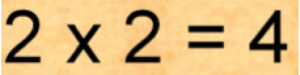
And that when you multiply one positive number by a negative number, the result is negative:

And when you multiply two negative numbers that the result is positive:

It follows that whether you square a positive number OR a negative number the answer is positive.
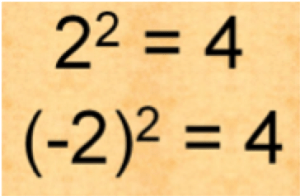
Since 2 squared equals 4 and negative 2 squared equals 4, this means that the answer to finding the square root of 4 could be 2 or negative 2 .
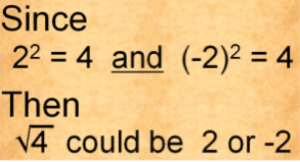
Whether we square positive 2 or negative 2 the result is positive 4. We can see that there is no real number multiplied by itself that can ever equal a negative number.

In the language of math, no real number exists that when squared will yield a negative number, so that means that square root of a negative number cannot be a real number.
And yet, when we use the quadratic formula to solve equations, the result is often a negative square root. In the 17th century, most mathematicians dismissed these resulting negative square roots as nonsense. Sir Isaac Newton referred to these numbers as impossible. Rene Descartes dismissed them as “imaginary” and the name stuck.
But a few Italian mathematicians looked beyond logic and began to work with “imaginary” numbers anyway. They basically said, “Let’s suppose they exist and let’s see what we can do with them.” From this basic “leap of faith,” they began developing logical rules to use imaginary numbers to solve equations that had previously been impossible to solve. Other mathematicians followed their lead and did more work that advanced the usefulness of imaginary numbers.
Nowadays, we use an italic i to represent the imaginary number the square root of negative 1.

We don’t use imaginary numbers to measure distance, or count things but they have many natural applications in electronics, science, medicine and economics. They help us describe real world phenomena, like electromagnetic fields, alternating current, fluid flow around obstacles, stresses and strains on beams, and resonance in tall buildings and suspension bridges.
Okay, your math lesson is over. But what does any of this have to do with religion?In my strictly logical brain, I do not believe in the square root of negative 1. However, when I take a mathematical “leap of faith,” I have no trouble learning how to use them to solve problems. There is beauty in arriving at an answer that makes perfect sense, even if the first step is based on letting go of logic.
Imaginary numbers exist because we humans imagine them. In a way, though, they were there all along, hidden in the universe since its very beginning, just waiting to be imagined and brought into full existence. Once they were defined and characterized, they “became.”
In my strictly logical brain, I do not believe in god. Much like the square root of a negative one, the concept of god goes against my natural logic. I think everything in the universe is merely a result of a natural series of events. My logical universe consists of evolution, coincidences, random occurrences as well as our human choices…a universe that moves along because of natural and human actions and the resulting reactions and cascading consequences.
However, like the mathematicians who explored imaginary numbers, I can take a “leap of faith” and say to myself “Let’s suppose god exists and see what I can do with him, her, it, that…”
Like imaginary numbers, I think god exists because we humans imagined god. In a way, though, god was there all along, hidden in the universe since its very beginning, just waiting to be imagined and brought into full existence. Once god was defined and characterized, god “became.” There is beauty in bringing god into existence, even if the first step is based on letting go of logic.
The concept of god I imagine is not the god that created the world in seven days, it’s not a controlling power over and above, not an immutable god, but a god of change. The god I imagine is some life force that was there waiting, even before the big bang…some tiny by infinite spark that propelled creation from primordial soup to a single cell to the intricate web of all creation we are immersed in today.
As Rev. Dwight Smith used to say, it is the god “to be,” the god that is everything happening that will be completed at an indefinite distant time.
But my imagining of god is not necessarily your imagining…All of us imagining a different god? Chaos! Isn’t that what’s causing all the strife in our world? Which of us imagines the real god? Who among us holds “The Truth?” We can’t all be right!
Or can we? Maybe people don’t just perceive god differently, maybe god is actually different for each of us. Maybe god actually is what each person imagines god to be.
Some people need god to be a father, so god is a father to them. Some people need god to be a Mother so god is a mother to them. Some people need a god that they can talk to, so god listens to them.
Some people need a god that appears in nature, or in love, or in health, or in illness, so for those people God resides there. Some people feel god above the earth, or outside their body, or inside, so god is wherever those people feel god’s presence. Some people imagine no god in their life, and so their life is complete without god. As Pat said, even nothing is something.
The good thing about having the god you imagine is that you simply have to imagine what god you want or need, and then god is that for you…and you can change your mind. In the middle of a crisis, if you need a god you can talk to, then god is listening.
I think Science and Religion are really the same thing…ways of trying to answer life’s big questions…why we’re here and why we’re gone, why we live and why we die. Science is working at the edge of what we know already and Religion is working at the edge of what we don’t know. Maybe god is just the sum total of everything we don’t completely understand but still believe exists.
As reasoning Unitarian Univeralists, Science provides us with the form and parameters of our universe while our religion gives us complete freedom to move around within those parameters.
One last math fact…for most applications, imaginary numbers are paired with a real number to create a conjugate called a complex number. For me, complex numbers−with a logical component and an imaginary component−are a good analogy of life. For every experience, event, or occurrence there is a complex explanation…the logical, factual part along with the imaginary, the part explained by the beliefs of the beholders.
Imaginary numbers teach us that our existence consists of the known and unknowable, the rational and the irrational, the real and imaginable. It is our duty to use our human reasoning to link the two together. There is room for reason and belief in our hearts and minds.
As Mark Twain said, “Faith is believing what you know ain’t so.”
~Written in February 2010
 School of Thought